Showing posts with label Feature. Show all posts

Wednesday, March 14, 2012

Corvette Evolution, Part 12: C5-R - Finally a True Racing Corvette

The C5-R was the first factory supported Corvette racing car, and it won the 24 Hours of Le Mans three times. 
During the first half of the last decade, a low silhouette racing sports car conquered not only American but also European racetracks. It was the Corvette C5-R, the first truly official racing effort of the famous American sports car.There is no official explanation for the change of heart from Chevy executives, after almost 45 years of complete disregard for racing Corvettes. However, the main objective for the investment was the desire to spread the reputation of the marque and improve sales.
The Corvette's choice for this assignment was a natural decision. However the claim that the racing program was also part of an international marketing and promotion effort is an exaggeration. Yes, the Corvette C5-R raced successfully at Le Mans, netting three class victories out of five starts, but the bulk of its racing efforts were done in the ALMS series.When the C5 Corvette arrived on the scene, everyone involved knew that when race-prepped it would be good enough to go head-to-head with the Saleen Mustangs, Porsches and Dodge Vipers in GT2/GTS sports car events in the North American theater.Chevrolet Race Shop had an enormous task at hand to start from scratch by putting together a race team and design a GT2/GTS race car based around the production C5.Pratt & Miller Engineering was hired to develop and construct the chassis under the direction of chassis engineer Ken Brown.Katech Engine Building and Development would handle the engine side of the racing equation. By November of 1998, the group finished the test mule and was working hard to complete and shake-down chassis' #1 and #2 in time for their debut in March of 1999 at Sebring.
The actual race chassis' were built, sharing only basic key structural elements with the production road cars. A firewall was placed immediately behind the driver's seat in the cockpit, eliminating any rear visibility from inside the car.A large diffuser and wing were added to the rear, while a splitter and vents on the hood were added to the front.The distinctive front headlights were also replaced with protruding permanent units in place of the pop-up headlights on the standard production car. Upon its initial completion, the C5-R came with a 366 CID (6.0-liter) V8 engine.This was replaced with a larger 427 CID (7.0 liter) engine several months later during the 1999 season and became the standard engine for the C5-R for the rest of its career. Katech Engine Development constructed the C5-R's engines, although they retained elements of the production LS1 units.
The C5-R made its race debut in 1999 at the Daytona 24 Hours, finishing second in its class. Its main competitor in the GT2 was the Dodge Viper. During that season performances weren't brilliant and no wins were achieved, but gradually the team gained experience and the car was development into a more competitive configuration.
In 2000 results improved with two wins in ALMS races. The team also, for the first time, went beyond U.S. borders and participated in the 24 Hours of Le Mans, capturing 3rd and 4th places in the GTS class.2001 was the first great year for the team and GM managers could see some return on their investment.The Corvette team won convincingly at La Sarthe, capturing the two highest steps of the podium and routing the opposition in the ALMS series with seven wins out of nine races. The Corvette C5-R was now firing all cylinders.The C5-R retired from racing after winning the 2004 ALMS title with a total of 35 ALMS race wins out of 55 starts. In 2004 alone the car registered a 100 percent success record with 10 wins out of 10 starts, in addition to a class win at Le Mans, the last of them in Laguna Seca Raceway."It's a very special year when you can go undefeated," said Doug Duchardt, GM Racing director, at the time. "This was an amazing effort from the beginning until the end. This is a great way to send out the C5-R."
Corvette Evolution, Part 12: C5-R - Finally a True Racing Corvette

Sunday, February 12, 2012

Mercedes SL Class Loaded with Electronic Wizardry

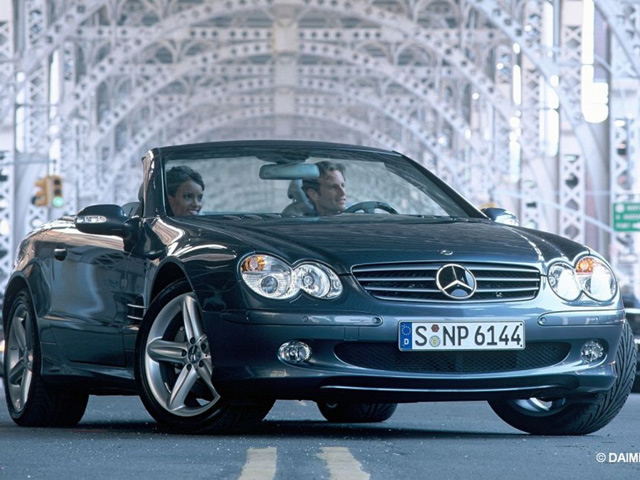
The Mercedes-Benz SL Fifth Generation: R 230 (2001-2012).
The fifth generation SL was unveiled in July 2001, presenting its unique variant of the automaker's then double-rounded-headlamp configuration theme. The transverse stripes were increased in size and reduced to three.However, the most notable exterior design change was the new bulbous roof, as opposed to the angular build of the previous generation. It accentuated the elongated hood along with the short and compact trunk and decorated the car with an energetic look.
The interior design was also changed as the cluster of three gauges was replaced with two separate round gauges.
The SL 500, with an output of 306hp, was the first model to arrive on the market. It was later joined by the SL 55 AMG with a supercharged V8 engine and 476hp. In 2002, the SL 350 featuring a 3.7-liter V6 with 245hp engine followed.And in January 2003 Mercedes-Benz finally introduced the 600 SL with the powerful 500hp 5.5-litre V12 biturbo engine as their new flagship model. The standard equipment included leather-upholstered seats plus a memory function for the electric seat and steering wheel adjustment.
Other standard features included a multifunction steering wheel, automatic climate control, and stereo car radio. As optional extras, innovative assistance systems like the DISTRONIC proximity control, the automatic emergency call system TELEAID, the control and display system COMAND or the electronic tire pressure monitoring system were available.A facelift was done for 2008. From the side view the air intakes in the wings are prominent (though there were also similar air intakes in the previous model), as they were a typical feature of the first 300 SL. The headlamps became less prominent and better integrated into the body work.
The hood was also beautifully shaped with two elongated bulges. The steeply raked windscreen emphasises the sports car character and accentuates the low, wedge-shaped silhouette. Unlike its predecessors, the R 230-Series SL always carried its hardtop build around a vario-roof system.At the push of a button the roof opens or closes in a 16-second process. An extremely complex swivelling mechanism ensures that the three roof components disappear into the upper part of the trunk.

Editor's Note: This was the final portion of our featured Mercedes-Benz SL series. We hope everyone enjoyed it.
 Mercedes SL Class Loaded with Electronic Wizardry

Thursday, January 19, 2012

Cadillac ATS to Challenge the BMW 3-Series

The new ATS is just the cornerstone of Cadillac’s strategy to become a serious player in the luxury segment and improve GM’s overall profits.
So far, the Detroit Auto Show has been a success for Cadillac: at its main exhibit, the new ATS received a standing ovation from the media who have high expectations of the resurgent car maker.Throughout its development, the ATS was compared to many rivals, particularly BMW. Now that the new car has been unveiled, more questions were raised to Cadillac senior management about the company's future targets and how it is going to challenge BMW and its fellow Germans, as well as Japanese brands.
One aspect of it going global is to have a more substantial presence in more markets around the world and offer cars that can compete in the luxury segment.For that to happen, the ATS alone won't be enough; in fact it should be Cadillac's opening assault. One of the rumors doing the rounds at Detroit was that a new small Cadillac SUV should be challenging the BMW X3.That makes sense; the only problem is that such a vehicle isn't available today at Cadillac showrooms. So Cadillac will have to make one, a process that takes time and consumes lots of money.
"We're looking at options there," Kurt McNeil, Cadillac's vice president of sales was quoted as saying by Bloomberg.com. "I think it would go a little bit more head-to-head with the X3. The fact that Cadillac is becoming more of a global brand will certainly play a role in that decision."What makes BMW such a target are twofold: first, last year it became the biggest luxury brand by sales in the US (though it was the target even before this achievement).More symbolic though is their reputation as great driving machines (rather than status symbols as is the case with Mercedes Benz vehicles).
Lately BMW has revived its legendary slogan "the ultimate driving machine", under which it is going to launch fourteen new models in 2012, compared to Cadillac's one. So if Cadillac's target is challenging BMW it really has to start developing new and more sophisticated vehicles.And if it wants to wrest the slogan from BMW, than we are in for a fascinating duel between the might of old corporate America against the potency of modern Deutschland AG.
Photos displayed are of the 2013 Cadillac ATS and BMW 3-Series.

Saturday, January 14, 2012

Dodge Aims the New Dart at Main Street

After seven years without a serious contender in the compact class, Dodge comes back and with a clear mission. 
Sergio Marchionne's efforts to revive the fortunes of Fiat Group brands and those of Chrysler Group brought us so far a mishmash of cars. It started off with badge engineering as Chryslers were rebadged as Lancias in order to save the Italian marque.That is an old industry trick and Lancia's success hangs in the balance because its situation in Europe is still deteriorating. But that was only the first move as the second one is building Dodge cars on European platforms.
Enter the 2013 Dodge Dart, a compact sedan that should bring Chrysler back into the competition in the compact cars segment. That segment accounts for roughly 10 percent of the US market and it's growing due to the unending economic crisis, new emission rules, and more frugal customers.In the past, Chrysler produced a few notable and popular compacts, such as the Neon in the '90s. Lately, however, it was represented in this segment by the Caliber, a hatchback that didn't find favor with US customers. It was designed during Daimler's reign and was a relatively complicated car to comprehend with its confusing appearance.
It appeared larger than what it really was and it resembled a crossover, though its target audience was people shopping for a small, simple and cheap car - not a Teutonic masterpiece.

In its first two years, the Caliber, which was intended to be a "world car," was also sold in Europe and China. It had initial success but later on sales dropped like falling off a cliff. The model was doomed and with Chrysler going into bankruptcy and the need for a new compact model for the American market, Marchionne decided to take a bold step by adopting a European platform (and he probably didn't have any other options).
The Caliber was such a poor product that Dodge now claims that for seven years the firm wasn't represented in the compact category."The compact sedan segment in the United States is the second-fastest growing segment in the industry, so (lacking a compact car) we've been playing with one arm tied behind our back," said Reid Bigland, Dodge brand President and CEO."When the new Dart hits the streets, we'll finally be back in the game, playing with 100 percent of the new-vehicle sales market."
The new Dart's look transmits a sporty feeling with Italian flavor due to its stance (and the bright red paint). The Dodge corporate front-end is prominent with its crosshair design and the familiar rear-end design taken directly from the Charger and Challenger.However, a few Alfa Romeo design cues are clearly evident such as the headlamp design and the overall side view silhouette.The interior design is also a significant improvement over the Playschool toy car interior of the Caliber. Emphasizing performance, the dual exhaust is also a unique feature for the segment.
Chrysler claims the Dart possesses plenty of Alfa Romeo DNA (what's bad with Dodge's?) so the three available engines are, as expected, of Italian origin and carry the MultiAir logo, a technology the Fiat Group developed in the last few years. This is not a bad thing in the least.
All three are gasoline engines, as the compact segment is still, for the most part, devoid of many of the new propulsion technologies.The engines include the 160hp Tigershark 16-valve 2.0-liter engine, a 160hp 16-valve 1.4-liter MultiAir Intercooled Turbo, and a new Tigershark 16-valve 2.4-liter MultiAir 2 four-cylinder.
Another unique thing that Dodge added is a gearbox lineup that includes a six-speed manual gearbox as the base option, a regular six-speed automatic, and an optional six-speed dual-clutch.
All in all, at least in the halls of Cobo Center, the Dart looks brilliant and offers the traditional automatic 2.0-liter compact car along with some spicier variants. When it finally hits showrooms in July and after several test drives, we'll know for sure whether Dodge is truly back in the game.

Friday, January 13, 2012

The 2013 Cadillac ATS: The New Standard of the World

This is the American sport sedan that will take on the German luxury brands. Let battle begin. 
Just a few days before Christmas, automakers began to shut down their operations for the holiday. However, Cadillac's new car test team was at the Nord Schleife, the famous picturesque track around the Nurburgring castle in western Germany.They brought with them a prototype ATS with a turbocharged 2.0-liter four-cylinder with 270hp and a second ATS packed with a 3.6-liter V6 equipped with the second- generation Cadillac Magnetic Ride Control suspension.
Two weeks before the opening press day of the 2012 Detroit Auto Show, the test run on the Nurburgring, the home track and development center of German luxury brands, further clarified a point that became even more evident before its Detroit premier: the ATS is going to beat the Germans at their own game.

"The ATS marks the debut of this brand's new rear-wheel drive architecture that's been optimized for agile, quick and fun driving dynamics," said David Leone, global vehicle line exec at Cadillac, adding that this platform was fine-tuned on Germany's Nurburgring. "We spent countless hours behind the wheel of this vehicle perfecting the final execution."
Going fast round the Nurburgring requires a lightweight car combined with a potent engine and an able suspension system. And the ATS is committed to fulfill each of those requirements. When it goes on sale in the second half of 2012, it will be, according to Cadillac, the lightest car in its segment with curb weight of 3,400 pounds.It will also have a sophisticated suspension system that will be offered in both rear-wheel and all-wheel drive. The bottom line is that the ATS is based on a new platform that will hopefully give Cadillac a better shot at their German rivals.
Weight reduction was achieved through the use of an aluminum hood, magnesium engine mount brackets and even lightweight, natural-fiber door trim panels."Low weight helps enable the ATS's driving experience, making it feel more nimble and controllable," said Dave Masch, ATS chief engineer. "Mass efficiency helps the car respond more immediately and precisely to driver input, and improves fuel efficiency."

The ATS's exterior design betrays its segment origins: its shape is more angular than any comparable German car.
The grille is almost rectangular and the headlamps are modern but, unlike their competitors, are in a portrait position rather than a landscape one.The interior design also carries Cadillac hallmarks and it should be nothing less, since the ATS is still an all-American car, after all.
The aluminum-intensive powertrains not only help to minimize overall weight, they are instrumental in favorable power-to-weight ratios that contribute to the ATS's willing feeling of performance. The 3.6-liter V6 is constructed of cylinder block and heads that are cast in aluminum.
A composite intake manifold saves approximately 5.5 pounds and an integrated cylinder head/exhaust manifold design saves approximately 13 pounds. The connecting rods are made of powdered metal with a higher ratio of copper, which makes them stronger and helps to reduce weight even more. The pistons are made of lightweight cast aluminum, which means there's less reciprocating mass in the engine for less inertia and greater operating efficiency.
At first, the ATS will be offered with three engines. A 202hp 2.5-liter four a 270hp comes standard and there's another, but more advanced, 2.0-liter four-cylinder turbo with more of a European flavor.
And finally there's the familiar 320hp 3.6-liter V6 as the more traditional American engine. The smallest engine, the 2.0-liter turbo, will be available with either a six-speed manual while a six-speed automatic transmission remains an option. The latter gearbox is standard for the 2.5 and 3.6 versions.

What's clearly still missing is an optional diesel engine. Mark Reuss, GM North America president, has promised that a diesel will soon be available. And in a very short time, we'll know for sure whether Cadillac has done their homework properly and whether they can truly reestablish themselves as the standard of the world.

The Best Concept Cars from the 2012 Detroit Auto Show

Will any of these concepts reach production? Only time will tell. Words by Jay Traugott
Concept cars have always been something of a conundrum for automakers. On the one hand, they often have no intention of producing them because they're supposed to only be design studies.But what happens when the public embraces a particular one and would love to see it reach production? In that case, the automaker may relent in order to satisfy buyers and prove they have the best designers in the industry.
Other times, too many great concepts remain just that and never see production. And from the CarBuzz editors, here are the best concepts from Detroit. If all goes to plan, each will reach showrooms floors, in some form, sometime in the near future.
Acura NSX Concept: Ever since the original NSX ceased production in 2005, fans and enthusiasts have practically begged Acura to build a replacement. The Japanese automaker was always keen to do it, but various obstacles (global recession, natural disasters in Japan) delayed development. But that's all in the past as the NSX Concept is everything we hoped it would be and so much more. Powered by the next-generation VTEC V6 with direct-injection and mated to a dual-clutch transmission, this mid-engined hybrid supercar comes equipped with Acura's Super Handling All Wheel Drive system.
It can instantly generate negative or positive torque to the front wheels during cornering. Also new is an electric motor that provides an extra boost in power.Pricing hasn't been announced, but it will be in showrooms in only three short years.
Lexus LF-LC Concept: With the exception of the LFA, Lexus has been in desperate need of a performance and styling revival for some time. And in an industry where styling is increasingly vital, Lexus has finally come up with something that may just do the trick.The LF-LC is a 2+2 grand coupe that we think is the most stunning thing ever to come out of the Lexus design studio in Newport Beach, California. Featuring bold and aggressive styling throughout, the LF-LC is anything but conservative with its sleek profile and pronounced front-end grille.
Its interior is also a significant upgrade from before with an abundance of polished wood trim, leather, and suede.The only question remains is whether Lexus will actually build it. Five years ago, we'd say no, but with ever growing competition and a need for brand definition, we wouldn't be surprised to see a production version in the near future.
Honda Accord Coupe Concept: After the mini debacle that's become of the newly redesigned Civic and some other models, Honda is desperate to show they still have style. The current Accord sedan is a bland example of their current lack of design ambition, but the Japanese automaker is out to fix that for the car's 30th anniversary.The Accord Coupe concept seen here is an early preview of the upcoming ninth-generation model. Although at first one may mistake it for the current car, a closer look will reveal that this concept has more aggressive lines and shorter overhangs. Power comes from a new 2.4-liter four pot with direct-injection that produces 181hp and 177lb-ft of torque.Honda also announced that they'll be bringing back the Accord Hybrid, which hasn't been on sale since 2007. This next generation hybrid will have a 2.0-liter inline four gasoline engine paired up with a 120kW electric motor that receives power from a lithium-ion battery.
Lincoln MKZ Concept: Oh Lincoln, where have you been for so long? That's the exact question the automaker has been asking itself lately. With the end of the long-running Town Car, Ford's luxury division is in desperate need of a product and design revival if they ever want to match cross town rival Cadillac in the quest to become a global luxury brand.Enter the MKZ. Penned by former Cadillac Chief Exterior Designer Max Wolff, the new luxury sedan represents everything Lincoln wants and needs to become within the next few years.
Featuring a panoramic glass roof that's integrated into the body, the MKZ's overall proportions are bold and fresh, two words that Lincoln has nearly forgotten.Overall, the concept is an elegant and dynamic preview of what we hope Lincoln will be producing in the next couple of years. The question is, however, is whether this design direction is fully transferrable to a production version? We'll have our answer soon enough.
Chevrolet Code 130R Concept: This one was an unexpected surprise. Dubbed the 130R, Chevrolet is clearly intent on luring in younger customers looking for a true performance coupe.Powered by a turbocharged 1.4-liter four-banger with 150hp and mated to either a six-speed manual or auto gearbox, the rear-wheel-drive concept also features advanced technologies such as eAssist tech. This includes shutting off its engine at stops, regenerative braking, and the use of smooth torque while accelerating. Although the interior is still in the design phase, Chevrolet claims they're intent on bringing the car to production. They also stated future buyers will be able to have high-tech toys such as WiFi, MyLink, and smartphone connectivity.With a target price somewhere around $20k, the Code 130R could very well be the performance bargain of the near future in addition to being a technological display for today's social media-obsessed youth.
Toyota NS4 Concept: Ok, just go ahead and say it: Who needs yet another Toyota plug-in hybrid? Most car enthusiasts are not a fan of this genre simply because there's no performance fun. All very true, but we can't deny the relevance of this rapidly growing segment.Toyota clearly feels the same way and much of their future lies within being the leader in green cars. With the phenomenal success of the Prius, the NS4 concept is actually an early preview of what the next generation Prius may look like. One of the biggest criticisms of the Prius is its bland styling.
If Toyota is truly serious about improving its design image, they shouldn't tone down the NS4's lines too much when heading to production.With its sleek lift back profile and trapezoid grille, we like where Toyota is heading. Along with advancements in extended range and charging time technology, the NS4 concept could turn into a Prius actually worth taking a closer look at.
Honorable Mention - Volkswagen E-Bugster Concept: The arrival of the third generation Volkswagen Beetle last year was a big deal and worth the wait. The German automaker corrected the many wrongs of the previous model by adding more aggressive styling and improved performance options for its iconic model.So we weren't surprised in the least when VW revealed their E-Bugster concept. It doesn't take much to figure out how the name came to be, but VW was clever to give it a unique design to further separate it from the production car. With its low roofline and shallow windows, this EV is loaded with the latest of VW's green technology. Sitting three inches lower to the ground than the regular version, its interior features EV-specific gauges that display energy consumption fluctuations with vehicle acceleration along with a screen that shows the battery's charge status and regeneration intensity. Sitting on a set of 15-inch aluminum wheels, the E-Bugster is an intriguing example of what may be in store in the coming years for the Beetle.
Photos courtesy of Autoblog/AOL.

Saturday, January 7, 2012

Jeep Leads Chrysler Resurgence

A 44 percent increase in sales for the iconic brand helped Chrysler Group to outperform its American rivals in the sales tables and leapfrog past Honda. 
Chrysler and Jeep, the parent company and its most famous brand, were the stars of the American car market for 2011. Chrysler Group sales astoundingly grew to 1.37 million cars and light tracks, an increase of 26.2 percent from the previous year.Jeep sales were also very impressive, having surged by 44 percent to 419,349 units. The day after this was announced, Fiat Group stated they had increased their stake in Chrysler Group by an additional 5 percent to a total of 58.5 percent.
And to the surprise of many industry watchers, three of Chrysler's brands were among the top ten of the best performing brands in 2011: Ram in 6th place with a growth of 21 percent and Dodge in 10th place, growing by 17.6 percent.Chrysler Group, whose sales in December jumped 37 percent (Chrysler brand sales grew by 83 percent due to the success of the 200 and 300 models), easily outperformed its Detroit rivals, Ford and General Motors. In a year in which sales in the American market grew by 10.2 percent to 12.75 million vehicles, GM sales grew by 13.2 percent to 2.5 million vehicles and Ford sales grew by 10.8 percent to 2.11 million.
Both automakers beat the industry average, but only by small margins. Chrysler leapfrogged past Honda into fourth place, whose 2011 sales dropped by 6.8 percent, to a total of 1.15 million units. However, they still trailed Toyota who finished off with a 6.7 percent increase to 1.64 vehicles.

Just as important, 2011 will be remembered as the year in which Hyundai and Kia continued to grow in the US.Surprisingly, Kia easily outperformed its senior sibling with a sales growth of 36.3 percent to 485,500 vehicles, compared to Hyundai's growth of 20 percent to 646,000 units.
Volkswagen, who pushed themselves hard in the US with a new factory and the new Jetta and Passat sedans, saw Jetta sales jump by 54 percent for the year. However, their general car sales increased by a more modest 26.3 percent, for a total of 324,400 vehicles.The fight for the most sold premium brand ended with a victory for BMW. They outsold Daimler with 303,500 MINIs, BMW cars and SUVs compared to Mercedes-Benz, Maybach and Smart's combined 272,100 units. BMW sales grew by 14.2 percent while Daimler sales by 17.7 percent. Lexus, who lead that category for the last few years, ended only in third place.
For exotic sports car brands, Ferrari sales declined in December by 8.6 percent to 138 cars but grew for the year by 10 percent to 1,701 units. However, its stable mate, Maserati increased its sales by 20 percent to 2,322 cars.2011 was definitely a year to remember for the auto industry, especially Chrysler. In a world economy that's still in a fragile state, auto sales, particularly in the US, were one of the very few bright spots.